
Refractive surgery with implants

Intraocular implants
Phakic implants (ICL)
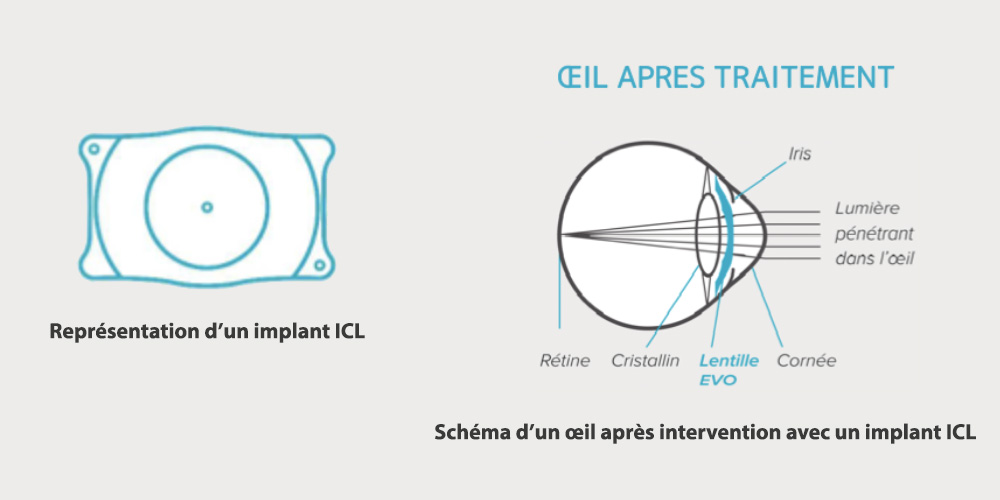
The ICL implant is a flexible refractive device made of Collamer, which is an advanced and biocompatible lens material.
This implant is positioned in the anterior chamber, more precisely behind the iris and in front of the lens. It is called "phakic" because the natural lens is still present in the posterior chamber.
This type of implant has been used since the early 1990s. The procedure yields very good refractive results (according to a clinical study, more than 99% of patients are satisfied) and offers excellent anatomical stability and is reversible.
What preoperative assessment is performed?
When selecting patients who may be fitted with phakic implants, the most important factors to consider are:
- The distance between the cornea and the lens, which corresponds to the depth of the anterior chamber (must be equal to or greater than 3 mm).
- Endothelial cell count.
- Refraction, thickness, diameter, and curvature radii of the cornea must also be taken into account.
- A topography, which corresponds to the mapping of the cornea.
Who are phakic implants intended for?
They are intended for patients with high ametropia for whom refractive surgeries by laser (such as PRK, LASIK, or SMILE) are not feasible due to insufficient corneal thickness or dry eye.
Phakic implants can also be offered to people who cannot wear contact lenses (dry eye, discomfort, poor tolerance, etc.).
The procedure
The procedure is performed on an outpatient basis, in the operating room, under local anesthesia by eye drops or general anesthesia and lasts less than thirty minutes. A small incision is made in the cornea allowing the folded implant to be inserted. Once placed between the iris and the lens, the implant unfolds and regains its original shape.
Postoperative period
Following the procedure, an eye drop treatment is prescribed by your ophthalmologist. Functional and visual recovery is rapid, and you can return to work a few days after the surgery. Some photophobia and dry eye sensations may be felt for a few days or even several weeks after the procedure.
Contraindications
- Endothelial cell density less than 2000 cells.
- The anterior chamber depth must be greater than 2.8 mm for myopic subjects and 3 mm for hyperopic subjects.
- Engaging in sports with a high risk of trauma.
- Scuba diving.
- Unstable ametropia.
Disadvantages
- More invasive procedure compared to laser surgeries.
- May accelerate the onset of cataracts.
- Requires monitoring of intraocular pressure postoperatively.
Pseudo-phakic implants (PRELEX)
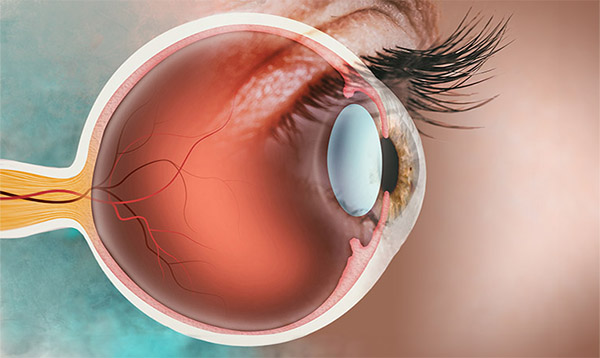
The term PreLex means PREsbyopic Lens EXchange. PRELEX pseudo-phakic implants are used in clear lens surgery, or in other words, for refractive purposes.
This technique involves replacing a lens that is not yet affected by cataracts with an intraocular lens (pseudo-phakic implant) to correct visual defects such as myopia or hyperopia, astigmatism, and presbyopia.
What preoperative assessment is performed?
A fundus examination and macular OCT allow analysis of the retina and macula. A specular microscopy assesses the quality of corneal endothelial cells. Finally, a corneal topography with axial length measurement is performed to determine the power and optimal positioning of the implant.
Who are pseudo-phakic implants intended for?
Clear lens surgery is mainly offered to people over 55 years of age who are not eligible for refractive surgery laser or as an alternative to laser technique depending on the correction required and the patient's clinical examination.
It is the same surgical technique as that used for cataract surgery, except that the lenses are not yet clouded and the PRELEX implant is used solely for refractive purposes.
The procedure
The procedure is performed on an outpatient basis, in the operating room, under local anesthesia. It proceeds similarly to cataract surgery: a small incision is made at the corneal limbus allowing the lens to be extracted through phacoemulsification. The capsule originally containing the lens is preserved to receive the implant, which acts as a lens to correct the visual defect. This implant is inserted folded and instantly unfolds to position itself within the capsular bag.
Postoperative period
Following the procedure, antibiotic and anti-inflammatory eye drops are prescribed by your ophthalmologist. Functional and visual recovery is rapid and painless. Light halos may be experienced for several weeks following surgery.
Contraindications
- Cornea guttata or other corneal dystrophies.
- Retinal diseases.
- Glaucoma.
- Optic neuropathy.
Disadvantages
- Onset of secondary cataract (clouding of the implant sac) a few years later (normal progression and very easily treated).
- Risk of retinal detachment (very rare).
recommendations
Since refractive surgery is not an option for everyone, it is important to undergo a preoperative evaluation with one of our specialized and qualified doctors to discuss the feasibility of the procedure, the benefits, risks and possible alternatives.
before the procedure
- Arrange for someone to accompany you on the day of the procedure. Do not come alone by car.
- Plan to bring a pair of sunglasses to wear after the procedure.
- Make yourself available the day after the procedure for a postoperative check-up.
- Remove your contact lenses: 3 days before the procedure for soft lenses; 8 days before the procedure for hard lenses.
On the day of the procedure
- Remember to bring the informed consent form duly completed and signed.
- Come with your companion.
- Remember to bring your pair of sunglasses.
- Do not come on an empty stomach. Have a normal breakfast before coming to the clinic.
- Do not wear makeup and thoroughly cleanse your face the evening before, focusing on the eye area.
- Do not apply perfume or deodorant as the laser beam is sensitive to solvents.
If you are very anxious, we can prescribe a mild anxiolytic. Upon your arrival at the clinic, you will be taken care of by the medical team. The procedure takes place in the operating room (controlled clean room) under topical anesthesia (eye drops). It lasts about half an hour under an operating microscope. After the procedure, rest in a room for half an hour or longer, then leave the clinic after the surgeon’s check-up.
We are here to assist you with:
✔ Answering your questions about refractive surgery and the available techniques.
✔ Guiding you in scheduling a preoperative assessment.
✔ Providing information about pricing and how the procedures are performed.
✔ Supporting you after your procedure if you need advice or follow-up.