laser refractive surgery in Lyon

Laser refractive surgery in Lyon
Laser refractive surgery can correct most vision problems effectively and permanently. The goal is to enable patients to go about their daily lives without glasses or contact lenses. Depending on the type of refractive error, age, occupation, and leisure activities, a pair of backup glasses may be recommended in some cases.
Myopia, hyperopia, astigmatism, presbyopia... what if there was an alternative to corrective devices? This is what ophthalmologists specializing in laser refractive surgery techniques in Lyon (Smile, Lasik, Presbylasik, PKR, and TransPKR) offer you. Effective, minimally invasive, and painless for most, these interventions allow you to regain sharper vision and put your glasses or contact lenses aside for maximum daily activities.
A brief reminder of vision defects that can be treated by laser refractive surgery in Lyon
Did you know that 7 out of 10 people wear glasses or contact lenses? Depending on their condition, they have difficulty seeing at a distance and/or up close. There are four main visual defects that can be addressed by laser refractive surgery in Lyon:
- myopia, which refers to blurred distance vision; ;
- hyperopia, which causes nearby objects to appear blurry and leads to eye strain. Need a surgery for hyperopia in Lyon? ;
- astigmatism, caused by a distortion of the cornea and which manifests differently in each patient (blurred and distorted vision, eye strain, headaches, etc.) Need a astigmatism surgery in Lyon? ;
- presbyopia, which is caused by the aging of the eye and leads to difficulty seeing up close (making reading particularly difficult).
There are different techniques for laser refractive surgery in Lyon
At our practice, we perform surgery on many patients each year to restore their vision to a satisfactory level without the need for glasses or contact lenses. To do this, we use various laser refractive surgery technologies in Lyon. Learn more at laser eye surgery in Lyon !
The minimally invasive Smile technology is suitable for treating myopia and astigmatism. The Lasik technique aims to improve vision in cases of myopia, hyperopia, or astigmatism. PKR or TransPKR treat the same defects as Lasik but after removing the epithelium instead of creating a corneal flap. Finally, Presbylasik effectively treats these three defects combined with presbyopia.
For any information on laser refractive surgery in Lyon – Smile, Lasik, PKR, TransPKR, Presbylasik – we invite you to make an appointment at the clinic with one of our specialized surgeons.
SMILE
This latest-generation technique is intended for all myopic and astigmatic patients who are well corrected by glasses or contact lenses but wish to eliminate optical accessories for clear vision.
> Learn more
LASIK
This technique is for all myopic, hyperopic, and astigmatic patients. LASIK covers all visual defects with limits mainly dependent on corneal thickness and pupil diameter under low light conditions.
> Learn more
PRESBYLASIK
This technique is for myopic, hyperopic, astigmatic, and presbyopic patients. PRESBYLASIK is the most frequently used solution in France to operate on presbyopia and achieve a compromise between distance and near vision.
> Learn more
PKR AND TRANSPKR
The PKR (and TransPKR) refractive surgery technique treats mild corrections of myopia, astigmatism, or hyperopia, but not presbyopia.
> Learn more
If laser treatment is not an option, we can offer you refractive surgery using intraocular implants.
smile
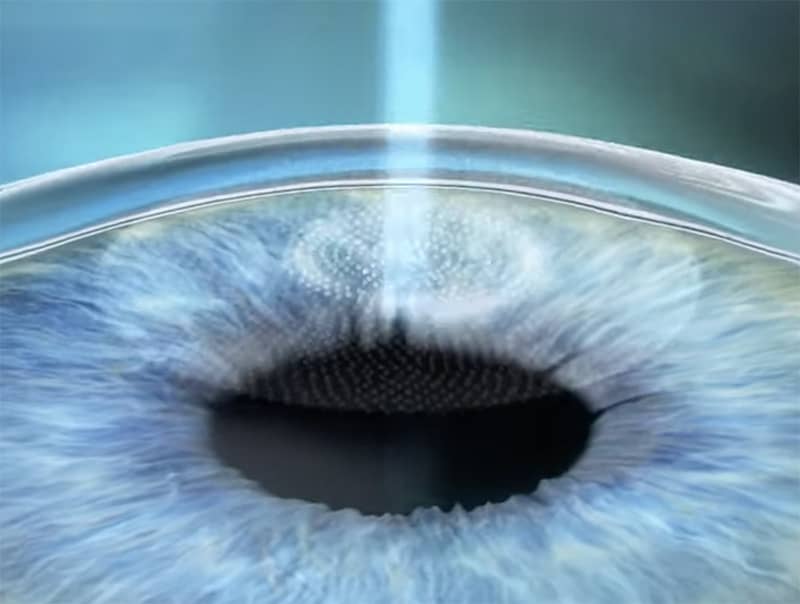
This is the most recent refractive surgery technique. The first SMILE surgery was performed in 2006.
The SMILE technique treats myopia and astigmatism using the Zeiss Visumax Femtosecond laser. This method reshapes the cornea by applying the laser without cutting a corneal flap (unlike LASIK). This preserves corneal integrity better and allows faster healing.
The total treatment time is about 15-20 minutes for both eyes, but the Femtosecond laser is applied for only about ten seconds per eye. A very thin stromal lenticule is then manually removed by the surgeon, and the treatment is complete.
The anesthesia is purely local; a few drops of eye drops are sufficient. An anxiolytic premedication may be prescribed. Resting with closed eyes for 3-4 hours is recommended after the procedure. It is also advised to avoid situations with infection risk for a week.
advantages of smile
- Preservation of the corneal ultrastructure due to the minimally invasive nature of this surgery.
- Enhanced precision: CARL ZEISS guarantees precision on the order of a micrometer.
- No complications related to the flap moving or wrinkling, so there is less risk if the eyes are rubbed.
- The tear film is preserved, and there is little sensation of dry eyes after surgery, as the procedure is minimally invasive and the corneal nerves are preserved.
- You can return to work very quickly after the surgery, since healing is very fast.
Scientific studies (by Dr. Dan Reinstein of the London Vision Clinic, involving more than 1,000 treated eyes and published in the scientific journal *Eye World*) have found high long-term corneal stability and a significant reduction in dry eye.
The SMILE technique allows for very rapid recovery with little or no dry eye after surgery and fewer flap-related complications.
the disadvantages of smile
- Higher cost than the LASIK procedure
- If a follow-up procedure is needed, it will have to be performed using LASIK or PKR techniques.
postoperative
- The day after the laser, vision is good.
- It takes 3-4 days for the vision to refine.
- Fluctuations and halos are possible initially, but disappear within about ten days.
lasik
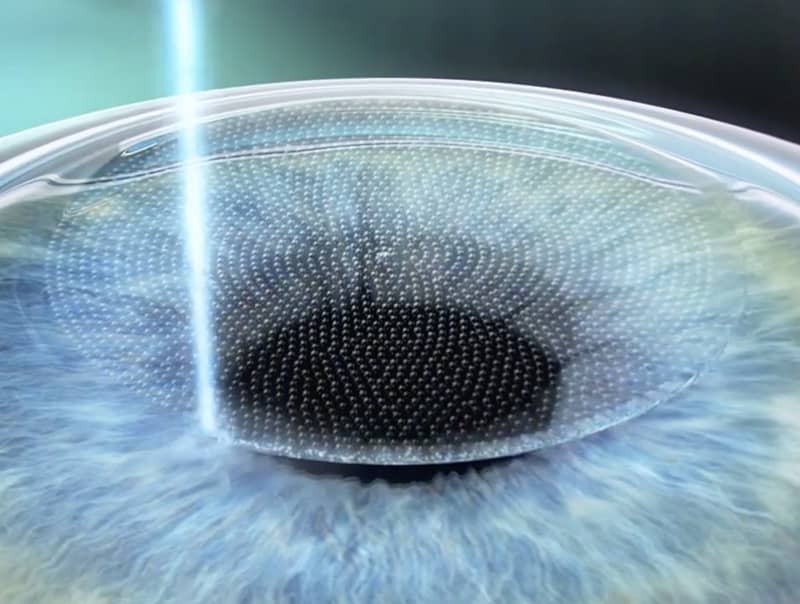
The LASIK technique has been practiced since the 2000s and offers optimal results for patients.
The laser treatment is performed within the corneal thickness after creating a superficial flap, also called a 'cap'. With the old so-called 'classic or mechanical' LASIK technique, the main source of complications was the cutting of the corneal flap, done with a mechanical instrument called a 'microkeratome'.
The Femtosecond Laser, much more precise, eliminates the need for this instrument and allows for nearly risk-free surgery, known as 'all-laser LASIK' or 'SUPERLASIK'. The creation of the corneal flap (or 'cap') is painless, quick, and precise.
The patient's ametropia (visual defect) is then treated by photoablation using the Excimer laser. After the treatment, the corneal flap is repositioned and spontaneously adheres to the underlying cornea within seconds. This technique enhances the safety of the procedure and significantly optimizes results.
the advantages of lasik
- Rapid functional recovery.
- Option to treat severe myopia and hyperopia, which are difficult to treat with PKR laser surgery.
- Quick return to work (within 48 hours), except in special cases (work in a dusty or dirty environment).
- Precision of the cut of the corneal flap.
The LASIK laser technique (femtosecond) is currently the safest technique, with the longest track record.
the disadvantages of lasik
- Possible sensation of dry eyes.
- Possible presence of light halos for a few months postoperatively.
postoperative
- The day after the laser, vision is relatively good.
- It takes about 8 days for vision to refine.
- Visual stability requires several weeks.
- Fluctuations and halos are possible initially but disappear within a few weeks.
- The final result is obtained after 3 months. In case of incomplete outcomes, a simple and harmless touch-up is possible within 6 months.
- There is no age limit for surgery. The key is to adapt the technique to the patient's age and lifestyle.
presbylasik
Presbyopia surgery is a compromise between distance and near vision.
Depending on the patient's needs, three binocular strategies (Monocular, Hybrid, and Monovision) are offered by our platform based on technology developed by SHWIND. Eye dominance will be measured at the preoperative appointment.
monocular
The dominant eye will be operated on for distance vision (LASIK) and the non-dominant eye will undergo PRESBYLASIK, providing the patient with depth of field. This method allows good distance and intermediate (computer, 50-60 cm) vision. Near vision will require supplementary glasses.
hybrid
Both eyes will be treated to provide some depth of field. The dominant eye is favored for distance and intermediate vision, the non-dominant eye for intermediate and near vision. This method provides distance, intermediate, and near vision.
Night vision halos may be disturbing for some patients. This technique is therefore not recommended for people who drive daily and on long journeys.
It is possible postoperatively to have small supplementary glasses for distance vision.
monovision
The dominant eye is operated on for distance vision and the non-dominant eye for near vision (binocular LASIK). This is called a shift and is limited. Indeed, the difference in correction between the two eyes cannot be too high as it causes reduced binocular vision (depth perception and distance estimation).
Generally, based on daily habits, patients are asked to choose between distance/intermediate or intermediate/near vision. Therefore, supplementary glasses for distance or near vision are often needed postoperatively depending on the chosen vision type.
PKR and TransPKR
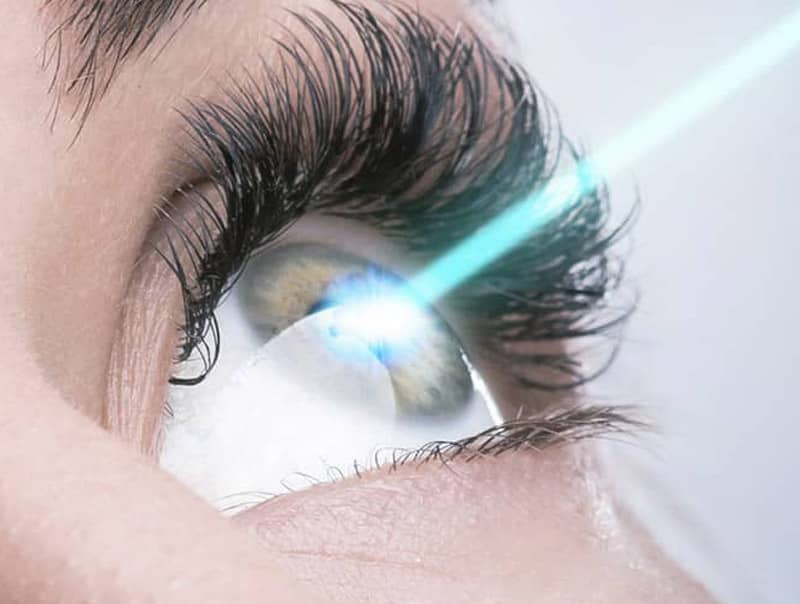
The refractive surgery techniques PKR and TransPKR (Photorefractive Keratectomy)
This technique is performed through photoablation of the cornea using the Excimer laser, so there is no flap cut, unlike LASIK.
TransPKR is a contactless procedure as the laser removes the epithelium, which is the surface layer of the cornea, then reshapes the intra-corneal stroma according to the visual defect to be treated.
The entire procedure lasts less than 10 minutes and anesthesia is local thanks to drops instilled just before surgery by the doctor. However, your stay at the surgery center is about one hour.
the advantages of PRK and TransPKR
- No risk of flap displacement.
- Eligible for thinner corneas.
the disadvantages of PRK and TransPKR
- Pain for 4 days (due to epithelium removal).
- Slower visual recovery than other techniques (several weeks).
- Possible sensation of dry eyes.
Find all the answers to your questions in video
recommendations
Since refractive surgery is not an option for everyone, it is important to undergo a preoperative evaluation with one of our specialized and qualified doctors to discuss the feasibility of the procedure, the benefits, risks and possible alternatives.
If laser procedures are contraindicated (PKR, tPKR, LASIK, SMILE), refractive implant surgery is also available to treat myopia, astigmatism, and hyperopia.
before the procedure
- Arrange for someone to accompany you on the day of the procedure. Do not come alone by car.
- Plan to bring a pair of sunglasses to wear after the procedure.
- Make yourself available the day after the procedure for a postoperative check-up.
- Remove your contact lenses: 3 days before the procedure for soft lenses; 15 days before the procedure for rigid lenses.
On the day of the procedure
- Remember to bring the informed consent form duly completed and signed.
- Come with your companion.
- Remember to bring your pair of sunglasses.
- Do not come on an empty stomach. Have a normal breakfast before coming to the clinic.
- Do not wear makeup and thoroughly cleanse your face the evening before, focusing on the eye area.
- Do not apply perfume or deodorant as the laser beam is sensitive to solvents.
If you are very anxious, we can prescribe a mild anxiolytic. Upon your arrival at the clinic, you will be taken care of by the medical team. The procedure takes place in the operating room (controlled clean room) under topical anesthesia (eye drops). It lasts about half an hour under an operating microscope. After the procedure, rest in a room for half an hour or longer, then leave the clinic after the surgeon’s check-up.